Blackjack Fundamentals as Foundations for Progressive Mobile Tournament Prize Structures
Viktor Griffin · Aug 7, 2026
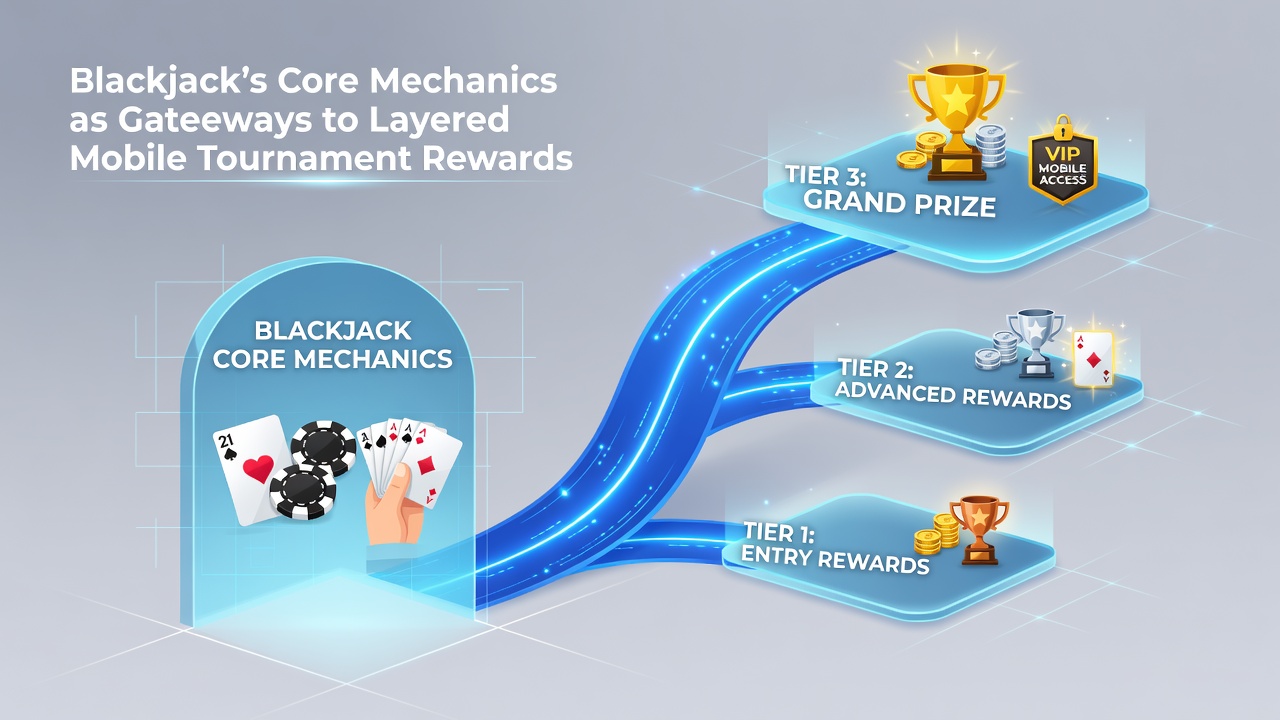
Blackjack Fundamentals as Foundations for Progressive Mobile Tournament Prize Structures
Blackjack operates through a set of defined actions that determine hand outcomes and influence player progression in mobile tournament formats, where core decisions like hitting, standing, splitting pairs, and doubling down translate directly into scoring systems that unlock successive reward layers. These mechanics establish the foundation for competitive structures because each choice affects both immediate results and accumulated points that feed into leaderboard positions across multiple tournament stages.
Core Actions and Their Direct Impact on Tournament Scoring
Standard blackjack rules require players to reach a total closest to 21 without exceeding it, and mobile tournaments integrate these same rules into point multipliers that reward optimal play sequences while penalizing deviations that lead to busts or suboptimal totals. Research from the Nevada Gaming Control Board shows that consistent application of basic strategy across thousands of hands produces measurable edges that platforms convert into qualification thresholds for higher tournament brackets. Splitting pairs creates opportunities for multiple active hands in a single round, which tournament software tracks as separate scoring events that can accelerate advancement through initial entry levels into mid-tier competitions.
Doubling down adds another dimension because successful execution doubles the wager and the associated points awarded in mobile formats, allowing participants to build cumulative totals faster than standard play alone permits. Data from industry reports indicates that players who incorporate doubling decisions at the mathematically correct moments achieve higher average scores per session, which directly feeds into the layered reward mechanisms that release bonus credits or entry passes upon reaching preset point milestones.
Progressive Reward Layers Tied to Decision Accuracy
Tournament systems divide rewards into sequential tiers where early performance based on fundamental mechanics determines eligibility for subsequent stages that offer larger prize pools. Those who maintain high accuracy rates in hitting and standing choices accumulate the consistent results needed to cross from open-entry events into invitation-only rounds scheduled throughout the year. In August 2026 several mobile platforms introduced updated scoring algorithms that place greater weight on splitting and doubling frequency, reflecting aggregated player data collected over prior months.
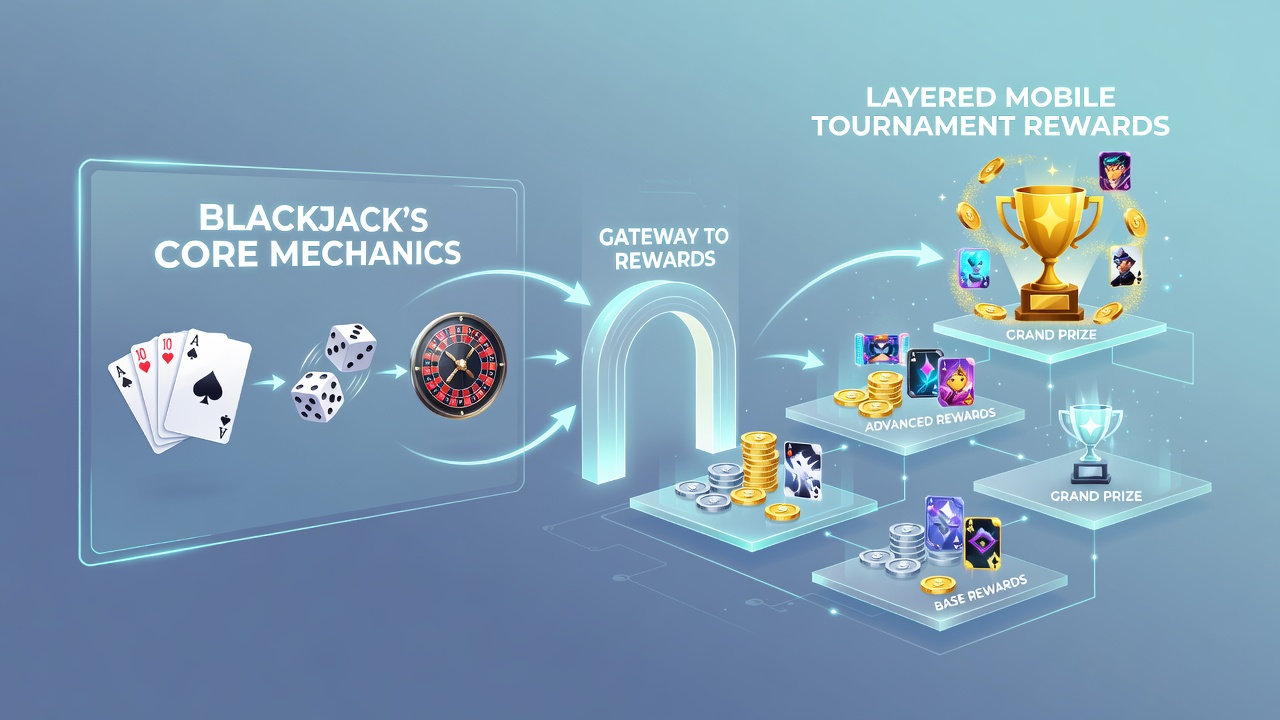
Insurance bets against dealer blackjack represent a less frequent but strategically significant option that tournaments sometimes weight differently in their point calculations. Observers note that platforms adjust these weights periodically to maintain competitive balance, ensuring that participants who master less common decisions gain access to specialized reward categories unavailable through basic play alone. Academic studies on probability modeling confirm that understanding when to decline insurance preserves bankroll and point totals over extended tournament sessions.
Mobile Interface Adaptations of Traditional Mechanics
Touchscreen controls in mobile applications replicate physical table actions while logging every decision for real-time scoring that feeds layered reward engines. These systems record sequences of hits and stands to generate performance metrics that determine how quickly a player ascends through reward brackets. Figures from regulatory analyses in multiple jurisdictions reveal that mobile formats now account for a growing share of tournament participation precisely because the same core mechanics produce verifiable data streams that platforms use to automate tier progression.
Live dealer integrations add visual confirmation of each action, which tournament software cross-references against optimal play charts to award accuracy bonuses. This verification process creates transparent pathways from foundational decisions to advanced reward access, where sustained performance across multiple sessions unlocks cumulative benefits such as reduced entry fees or enhanced point multipliers in later stages.
Conclusion
Blackjack's established mechanics function as the operational core that mobile tournament platforms convert into measurable progression metrics, enabling structured advancement through reward layers based solely on decision outcomes and consistency. The integration of hitting, standing, splitting, and doubling rules into scoring algorithms creates direct connections between traditional gameplay and competitive reward structures that continue to evolve with platform updates.